Wednesday, 17 March 2010

The book that's not for children and who's afraid of the big bad wolf?

I finished reading this recently:

This book was, for the most part, dull. There are 17,000 characters intricately involved with each other - kind of like Love Actually based in 1895. The Children's Book is indeed a page turner. A page-turner in the sense that I regularly turned ahead a few pages to see when the scene would end. It got better towards the two-thirds mark, which, in a book of 600 pages, requires some staying power. My staying power was that I had paid for this book and not borrowed it from the library, which is how I usually acquire my literary material.

What attracted me to this book was the cover (I'm ashamed to say it, but I am extremely shallow in the book cover department. If it has a colourful sketch of a twenty-something 'careergirl' alongside either a handbag or a lipstick, move along please), and also the fact that it was recommended as a 'read of the year' on the TV Book Club. I should have realised as soon as I saw the panelists: Gok Wan was one.

This book was not riveting, even though it includes horrific themes such as father/daughter pornographic pottery, and children being brought up in a house so bohemian they don't even know who their mother is out of their 'mother' and maiden aunt. Same father.

Some parts were just infuriating: in particular, long, boring scenes describing in detail a puppet show. All the action happens in the last third, so for this reason I would not reccommend The Children's Book.

I have just started reading Wolf Hall by Hilary Mantel, currently #2 on WH Smith's fiction chart. The Times promises it to be "the most gripping book you will ever read". 70 pages in I am not convinced, but I'm looking forward to it. It's (no prizes for guessing) historical fiction, but this time based on the Tudors. I'm not the biggest Tudor fan, but seeing as a few months ago I visited Hampton Court and really enjoyed it, now I have something visual to work with. Wolf Hall is an unofficial, jazzed-up biography of Thomas Cromwell, King Henry VIII's right hand man.


I'm sure you can't wait for the review of this beast.

Tuesday, 16 March 2010

Famous people from my town

Probably not interesting to anyone who doesn't live in the Rossendale Valley.

1. Agyness Dean (model)


2. Henry Holland (designer)


3. Jane Horrocks (the original Little Voice and voiceover for Tesco adverts)


4. Sir Paul Stephenson (chief commissioner of the Metropolitan Police)


5. Betty Jackson (designer)


6. Natalie Casey (ex-MTV presenter and Donna from 2 Pints of Lager and a Packet of Crisps)


Population: Not a lot

Valid famous people: 6

Obviously our most enthralling claim to fame, apart from the questionnable ski-slope that acts as an identifying location for any people unsure of Rawtenstall's whereabouts, is Agyness Dean the supermodel, who, like I, went to Bacup and Rawtenstall Grammar School and sixth form. This blogpost was inspired by Agyness's update on Twitter:

Just remembered that Woolworths is no more!!!! The 1 in Rawtenstall is now an Ethel Austin's store instead. I want pick and mix! What now?


I used to work at the very Woolworths that Agyness used to select her overpriced confectionary from. I worked there for £3 an hour until I saw the rota in the brown-carpeted, 1940s-based staff room which said I was to work at 6.30am on Boxing Day. This, combined with the fact that I had to wear a nametag that said Rusna, and a borrowed Woolworths polo shirt that was a size 16, made me quit.

Monday, 15 March 2010

Sunday, 7 March 2010

Why I can't quite make the change to Wordpress...

1) It is extremely difficult to do anything on.
2) I want my Alice picture as the header, and it will only let me use a very narrow portion of this.
3) It says *blog name*... 'Just another Wordpress weblog'. Oh well thanks for reminding me how insignificant I really am in this world of blogging, I don't need reminding every time I look at my blog.

Thursday, 4 March 2010

The Blind Side


So it's Thursday night, I'm supposed to be transcribing quotes from the pages of Newspaper Power for an essay on political bias... but instead I shall praise the privilege of being a member of SeeFilmFirst, and seeing them for free as well as first.
My boyfriend and I went to see The Blind Side starring Sandra Bullock the other night. It's a true story, based on the life of NFL star Michael Oher (pronounced Oar, like in the boat).
Michael Oher (Big Mike) should statistically have been a failure; probably a drug-addict, wife-beater, drive-by professional or all three. Brought up in foster families in the projects of Memphis, he was known as "the runner" as he would never stay with the family he had been placed with, always escaping to find his birth mother who would prefer a night with the crack-pipe than a night tucked up reading stories to her 12 children.

The Tuohys are the perfect American Republican family-of-four, of whom the patriarch owns 85 Taco Bells. One evening, the Tuohys spot Big Mike on the side of the road in his oversized clothes that he washes in the sink at the laundrette. Being God-fearing Christians, in a selfless gesture that seems inherently unrealistic and even downright stupid, the family offer to put a roof over his head, clothes on his back and food in his belly. No strings, no preliminary trial.
The filthy-rich white family take in the huge homeless black boy and let him sleep on their $10,000 couch. And that night was the beginning of the rest of his life.

Sandra's performance as Leigh Anne Tuohy is impeccable and reminded me of the Southern Belle busybody mother of Britney, Lynn Spears.
The film is feel-good and has more than a generous helping of cheese, but it was all real. Which makes it remarkable. It's the real-life Ryan Attwood in the O.C. It's a refreshing example of Christianity to the point of fairy tale, but proves that not all parts of religion are corrupt. It's one family's effort to overcome prejudice and racism. It's a bit of sunshine; straightforward and lovely.

If I hadn't been offered a free ticket to this film I probably would have never seen it, but I'm glad I did.

Monday, 1 March 2010

The Creepy Bones

Saoirse Ronan is doing pretty well for herself. The 15-year-old Irish actress (her name is pronounced Sorsha) has got two impressive films on her CV - 2007's Atonement and now Peter Jackson's The Lovely Bones. Both of which I loved. I don't understand exactly why it is called The Lovely Bones, but then again I didn't know what atonement meant until I just Googled it.

Having read the book in summer 2006 on a balcony in Puerto Banus, Spain, I couldn't remember anything of the storyline when I went to see the film. I remember being mildly terrified at some parts of the book, in particular one night when my family went out for dinner with friends and I remained on the balcony alone as it crept towards midnight. I remember deciding to move inside the apartment at one point and swap the book for a John Legend CD; so convinced was I that I was going to die alone in that apartment.

I digress.

The Lovely Bones should not have been awarded a 12A certificate. Whilst it was not graphic, the suggestion was bad enough. I would not chaperone an eight-year-old to see a film which involves a man lying in a blood and mud-filled hot bath, with a facecloth over his face, in eerie silence whilst a charm bracelet chinks against a blood-soaked sink with a knife in it.

And nothing is scarier than being trapped underground (not that it has happened to me) with porcelain screaming clowns surrounding you, with a paedophile, who at some point during your short time down there you realise is going to kill you. So you run for the ladders leading back up the earth, but, of course, you are an insect in a jar and can't get up the sides.

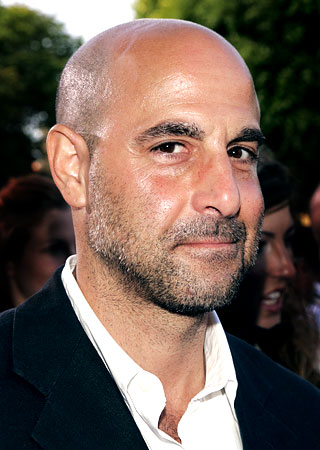
Stanley Tucci is terrifying as Mr Harvey. Who'd have thought that Gay Nigel from the Devil Wears Prada, the lovely, cruel-but-kind fashion assistant at Runway magazine who plays mentor and guardian angel to green Andy, could play such a part? Misty blue contact lenses, huge glasses, a toothbrush moustache and pervert-esque combover render him unrecognisable.

I mean.........


Italian Stallion to pervert neighbour in a few hair implants.


Saoirse's face is slightly annoying because it means you're in for another five minutes of her running towards rainbows or sashaying through fields of corn when it comes on screen. But apart from these slightly boring other-worldy parts that Suzie Salmon (the dead girl) frolicks in whilst she is waiting to get to heaven, the Lovely Bones is a fantastic film that makes you think about it long afterwards. If only about how the Devil Wears Prada is ruined forever.

Friday, 26 February 2010

Alive in Wonderland. (Sorry, the Alice stuff will stop soon)

Alice in Wonderland is the original children’s story. But Tim Burton’s blockbuster version of Alice will be watched mostly by adults, a) because of Johnny Depp, and b) because the story of Alice in Wonderland has fascinated children and adults alike since the Victorian era. The blue dress and blonde hair; the Cheshire cat; the white rabbit; the Mad Hatter; the Queen of Hearts are all iconic images from the story and loved by children of all generations. The hallucinations, drug references and sinister conspiracies of paedophilia surrounding the story’s origins are analysed by adults looking for a method to the madness. And mad it is: every character in the classic Victorian novel seems to be high on something.

In 1865 a gentleman named Charles Ludwig Dodgson wrote a story for his friend’s daughter, Alice Liddell, about her adventures underground. He published it under the name Lewis Carroll, and pretty soon every middle-class home in Victorian England had a leather-bound copy in the nursery.

Fast-forward 145 years. 3D glasses have replaced reading glasses, cinema seats have replaced the fireside rug, and Charles Dodgson would be turning in his grave should he know that an actor is being paid tens of millions of pounds to play the Mad Hatter.

Tim Burton’s Alice in Wonderland is set to be the most popular film version of the story since Disney’s sugary-sweet cartoon in 1951.

Full of singing pansies and cuddly, cute creatures, it was well and truly Disney-fied, ending with Alice sobbing that she wanted to go home. But the original book, despite being a children’s story, is a classic piece of literature that openly references drug use, manic depression and the feeling of being totally disillusioned. Alice doesn’t have a Ron and Hermione to chat things over with when she’s left holding the baby (literally: the one she rescues from being shaken violently by its mother in the house in the woods – not very Disney). Nor is Alice a cautionary tale; there is no moral to the story like so many children’s stories around now, promoting acceptance and harmony. Disney also coined the blue dress, white pinafore and black Alice band; in the original book Alice has brown hair and a yellow dress with stripy tights.

If Alice was published now it would not conform to PC guidelines: an opium-addicted caterpillar encourages Alice to smoke it and then challenges her to sing a nursery rhyme; the Mad Hatter celebrates his ‘un-birthday’ 364 days a year with a never-ending tea party, getting crazier and talking in riddles the more tea he drinks; every time Alice eats a ‘mushroom’ or drinks something her perspective changes, and the Queen is so bloodthirsty she has her entire court beheaded in a fit of rage.

We must remember, however, that in 1865 drugs such as opiates, cocaine and laudanum (a painkiller that was dangerously addictive made from opium) were available over-the-counter. Queen Victoria took cocaine for her period pains. So referencing drugs in a children’s book would not have been as absurd as it is today, even in a society where not much shocks anymore.

Indeed, the book was banned, but not in Britain and not for a reason as rational as drug-taking. In 1931 in Hunan, China, authorities banned Alice because they believed animals should not use human language because it put them on the same level.

Tim Burton’s film will definitely keep Alice in the public eye for years to come, but without him Alice certainly wouldn’t have an expiration date. Gwen Stefani’s first solo album was entirely modelled on the character; her What You Waiting For? video a modern Vivienne Westwood version of Wonderland with white tights, huge platforms and Japanese girls dressed as white rabbits. Girls looking for a good time can buy ‘sexy’ Alice in Wonderland fancy dress outfits on eBay. There is even an ‘Alice in Wonderland’ syndrome, a form of dysmorphia where people hallucinate everyday objects as freakishly proportioned.

The 21st century is not ready to give up the little girl who falls down a rabbit hole, as countless other drawing-room tales have fallen into oblivion. Alice personifies innocence, naivety and a fear of the unknown in a world where nothing is as it seems. In other words, it is timeless concept that is remarkably relevant 150 years later.

Now if you’ll excuse me, I’m late for a very important date.

Sunday, 21 February 2010

A half-baked attempt at fashion week

Something unthinkable has happened at London Fashion week. No, they haven't brought back paisley; designer Mark Fast employed a handful of "plus sized" models from agency 12+ to walk his designs alongside "normal" models.
Plus sized and normal are both in quotation marks because they are euphemisms. Size 10 (US size 6) and over is classed as plus size in fashion terms.

I was delighted at first: great, maybe this will be the start of something, I bet they look fabulous, I bet Crystal Renn is doing it... oh wait...is that lycra? And beige lyrca at that..? Things got pretty ugly the further down I scrolled.


Sigh. It seems Mark Fast does not actually care about normal sized women, because if he did he certainly wouldn't put them in beige lycra. It also seem that he has not bothered to make clothes that are actually their size - he has stuffed them into dresses two sizes too small for them. Apparently Mark Fast only cares about what will get him in the papers; needless to say, it is the plus sized models and not his clothes, which, by the way, you can see are horrible.


These women have been put in clothes that purposefully accentuate their wobbly bits, which kind of defeats the object. But don't hate the player, hate the game.

It would have been lovely if he had put Crystal or blondie in this design:


...but it seems he is saving the actual fashion for the actual models.

Monday, 8 February 2010

The Little Stranger - more than a little strange

After having read all five of Sarah Waters's novels, and enjoying all of them, I thought it appropriate to review her latest publication: The Little Stranger, which came out last May.

Waters, like me, is big on historic domesticity. Victorian parlour stories and whatnot. Her stories are about 'normal' people and the dynamics that happen within households. She writes about these so vividly it's as if she were alive at the time - how does a woman in her forties recall in such colourful detail the awkwardness of 1940s class distinction in Stranger; the charged atmosphere of bombed and blitzed London in WWII; the babyfarming industry in the crime-choked streets of Victorian London?

But Waters, unlike me, is a lesbian. This is what makes her stories extra-delicious for me - there is no boring, predictable heterosexual love story between the protagonist and their object of affection. Which is exactly what happens in Stranger. So I was surpised when Waters introduced the main woman character of Caroline, describing her as butch, unpretty, plain and clever, and then did not give her a lesbian storyline. Instead, there is a rather stolid, mundane theme of heterosexual desire between her and the loveless, dull protagonist, Dr. Faraday.

Stranger sells itself as a ghost story; a 'chilling' one at that. I don't know if it was because my brother was playing Dante's Inferno on the XBox for the majority of my reading it (I wouldn't read a 'chilling ghost story' alone in my room), but I was not chilled, and I am usually the easiest person to chill. The ghostly happenings and supernatural occurances in Hundreds Hall, (who is undisputably the main character in the book) were slightly contradticted by Dr Faraday's resolutely down-to-earth beliefs.

I read the first hundred pages quite easily; a Sarah Waters reader knows it would be foolish to abandon her early on, even if the material drags. And this dragged. I was expecting a punch-in-the-gut plot twist, as in Fingersmith, but it didn't come. So I persevered the other four hundred, but no explanations; no twist. In fact, the story ended extremely abruptly and in an entirely unsatisfying way. It would be rude of me to give the ending away, but there is nothing to give.

Perhaps I set my sights too high, but Stranger is not a page-turner. Waters has let down her page-turning fans. Stranger is one big anticlimax. Stick to the Victorian lesbianism, Sarah!

Monday, 1 February 2010

Public Transport is a euphemism

The other day I embarked the 12.22 train to Colne at Preston station, and sat down. Across the aisle was a table with two teenage boys sat either side, wearing sports jackets and blackened teeth. They were laughing and drinking from cans; shopping bags taking up the seats next to them. Lying on the table between them, next to their phones, was a baby girl. She was quite contented, on her back kicking her legs in air every so often, whilst her father jovially chatted over her.

This scenario was equally disturbing and amusing. Amusing for only one second, because it was so weird, and then it ceased to be amusing. Cue disturbia. I watched out the corner of my eye for several minutes; perhaps the father was about to change her nappy on the table? Which would have been disgusting, but why else would his approximately five-month-old daughter be lying on a plastic table meant for laptops, with no visible means of restraint preventing her from tumbling into the shopping bags or into the aisle should the train turn? No such nappy-changing was to happen, though, and the baby remained in this position, gurgling in wonder at the carpeted ceiling, for my entire train ride.

This is just one example of how unpleasant, surprising and eye-opening public transport can be. I once sat opposite a woman who was asleep on the train; her false teeth completely dislodged and gently resting on her bottom lip, constantly on the verge of falling out and potentially skidding across the table into my lap.

As well as playing witness to the salt of the earth, there is also the infuriating delays as well as having no clue when a bus is going to come, if at all. Also, all buses smell of dogs. Or the people on buses, even if they don't look like a dog person. This morning I breathed through my mouth for the entire twenty minute journey because the man in bleached jeans with a gold ring on every finger and a dusty bobble hat STUNK of dogs. On my return journey, I got to the bus station and saw in the queue for the 464 bus: a dog. And a man who had dog hairs plastered on every inch of his waterproof babygro. I don't hate dogs, I just hate people who smell of dogs. I have friends who have dogs, and they don't smell. One friend has five dogs and smells only of perfume and freshly laundered clothes. I just don't understand why these people smell: do they allow their dogs to lay in their clothes before they put them on? And why is it these people are only on buses? I never come across them in everyday life; only on public transport (which I only use when I have to go to uni).

The moral of this story is that I need to pass my driving test soon so I can pay £1600 insurance to not smell dogs.